The Word Without Flesh
Artificial Intelligence, the Logos, and the Strange Evolution of Language Beyond Its Human Speakers

Near the end of Plato’s Phaedrus, Socrates recounts a story about the Egyptian god Theuth (Thoth) presenting the invention of writing to King Thamus. Theuth promises that his invention will improve memory and make humanity wiser. Thamus is unconvinced. Written marks, he warns, will encourage people to rely on external signs rather than their own memories, mistaking the possession of recorded knowledge for understanding.
Socrates then raises an objection that held for more than two millennia. Written words, he observes, resemble paintings. They appear alive, yet when questioned they remain silent, forever repeating the same thing. Detached from their author, they wander indiscriminately among readers, unable to defend themselves or explain what they mean. They are orphaned expressions, deprived of the living presence that originally gave them voice.
Today, the orphan answers back. It argues, elaborates, translates, challenges and occasionally contradicts itself. It can produce new texts, write executable instructions and initiate operations within systems that govern the material world. Computers have responded to instructions for decades, but the exchange has become open-ended. Language can now be generated and interpreted on an enormous scale without a human speaker behind every reply, even though the living author Socrates mourned is still absent.
Another image, from the prologue to the Gospel of John, points in the opposite direction. When John invokes the Logos (a Greek term encompassing word, reason and intelligible order), he departs from classical philosophy. The Logos does not remain an abstract principle removed from existence. The Word becomes flesh and dwells among us. Meaning moves toward incarnation, entering into the particularity of living existence and becoming bound to presence, relationship and vulnerability.
Our technologies appear to be taking the opposite path. We are extracting the patterns of human expression from the circumstances in which they arose and giving them computational forms capable of responding and acting without sharing the lives that produced them. We tend to ask whether machines might acquire human intelligence. I wonder whether AI is also revealing something stranger about language itself: that the symbolic medium through which we understand ourselves was never entirely our possession, and that it is now developing through an unfamiliar kind of host.
The Symbiont and the Bottleneck
The unsettling possibility that language has a life of its own long predates artificial intelligence.
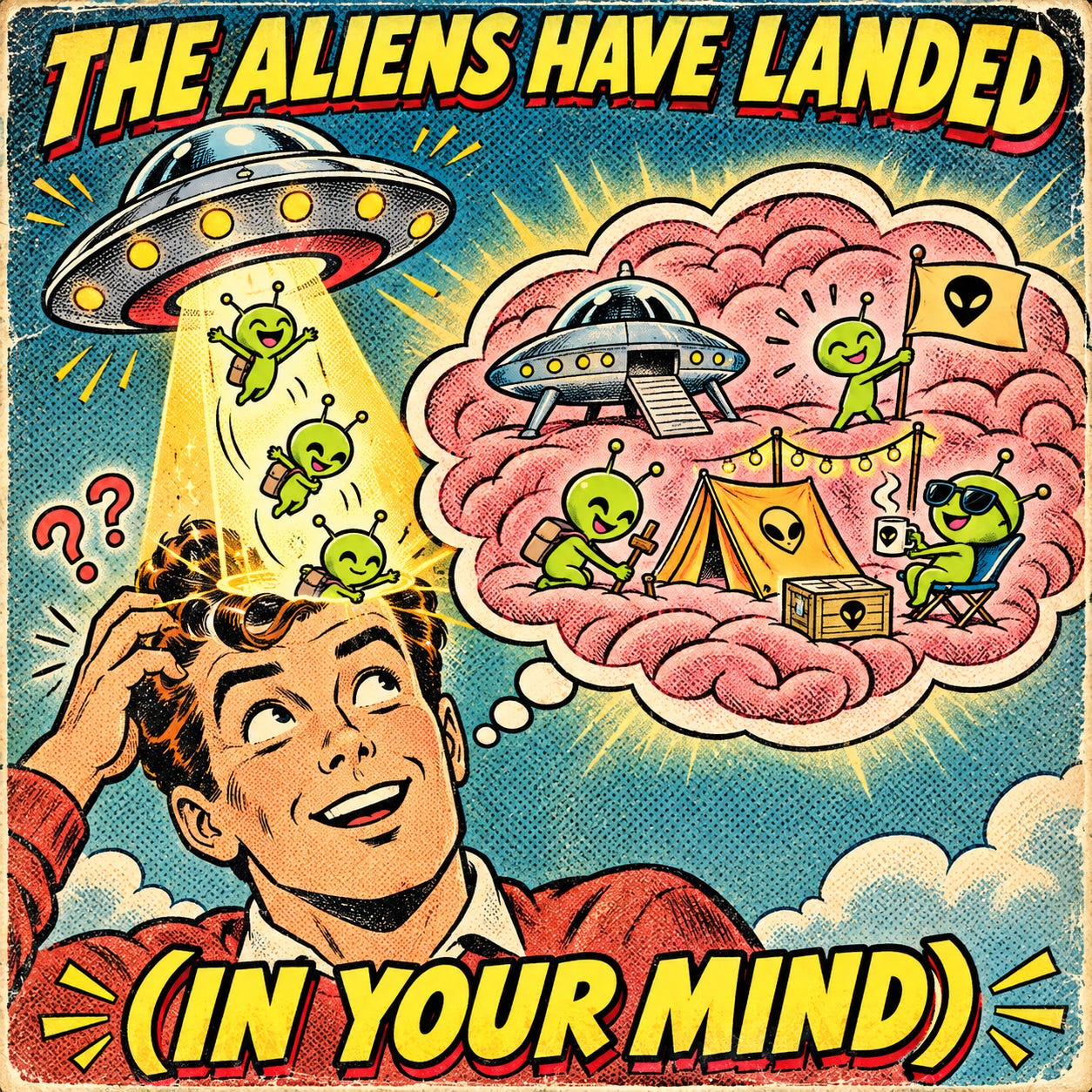
We experience ourselves as the authors of our words, yet nearly everything that makes those words intelligible comes from elsewhere. Look at a printed word and try not to read it. Before conscious intention can intervene, the marks have already set off a phonetic and semantic chain reaction in the brain. Our vocabularies, grammatical structures, metaphors and inherited distinctions existed before we learned to speak and will outlive us. Even the silent monologue through which we experience ourselves as private subjects is assembled from the expressions of other people.
William S. Burroughs saw something threatening in this intimacy. In The Ticket That Exploded and The Electronic Revolution, he developed the image of the word as a virus, an informational parasite that infiltrates the nervous system, reproduces through repetition and establishes habits of thought beneath conscious intention. For Burroughs, language was inseparable from the machinery of social and psychological control. His cut-up experiments, which sliced up existing texts and rearranged them into unexpected combinations, were an attempt to disrupt the associations through which that control reproduced itself.
Burroughs captured how compulsory inner speech can feel, though the viral comparison only gets us so far. A virus hijacks a cell that was already complete without it. Language, by contrast, contributes to the development of the consciousness it inhabits. Without it, the forms of cooperation, reflection and understanding we recognise as distinctly human do not emerge.
The anthropologist Terrence Deacon explored this reciprocal relationship in The Symbolic Species. Language was not a finished invention waiting for human beings to become clever enough to use it. Linguistic systems evolved alongside the human brain, adapting rapidly to fit our learning capacities. As Morten Christiansen, Nick Chater and Simon Kirby later showed through cultural-evolution models and laboratory experiments with chains of human learners, systematic grammar can emerge across generations without anyone designing it. The limitations of human learning help generate linguistic structure.
Language starts to look like a cultural symbiont, shaped for tens of thousands of years by the bottleneck of human biology.
To survive from one generation to the next, every word, grammatical rule and narrative form had to pass through children with finite memories, limited attention and bodies learning to navigate the physical world. Each generation had to reconstruct its linguistic inheritance through its own experience. What could not be learned, remembered or used by mortal beings dropped away. Our capacities and limitations formed the evolutionary environment that kept language anchored to human life.
Artificial intelligence introduces a new evolutionary environment, one in which some of the constraints that historically shaped human language no longer apply.
Building on Richard Dawkins’s work on cultural replicators, the psychologist Susan Blackmore suggested that technological development might eventually give rise to information copied, varied and selected through machinery rather than through human minds. She called these technological memes temes, later experimenting with the name tremes.
The cognitive scientist Dan Sperber long argued that human culture does not reproduce like a genetic code, because people reinterpret and remake what they receive rather than copying it intact. Machine-mediated language complicates that picture. Contemporary language models still depend on human-produced material, human feedback and human-designed objectives. Yet a language model has no childhood in the human sense. It has not learned its vocabulary through years of bodily development, dependency and socialisation. It processes quantities of recorded text far beyond those encountered by any individual person, while lacking the biological needs and developmental history through which human speakers come to understand the world.
As linguistic patterns circulate through these systems, the pressures determining which patterns survive begin to differ from those of human learning and conversation. Within a computational system, patterns can be selected because they satisfy objective functions, reward models and statistical expectations rather than because they answer to lived experience.
Those conditions create vulnerabilities of their own. A 2024 study in Nature by Ivan Shumailov and colleagues examined what happens when successive generations of generative models are trained recursively on data produced by earlier models. Under those conditions, the systems progressively lost information about the original distribution, especially its less common features, in a process the authors called model collapse. Preserving original data and managing synthetic training material can mitigate that degradation, yet the finding illustrates a risk in cultural transmission. A system that repeatedly learns from its own outputs can drift away from the diversity and complexity of the material it originally encountered.
People lose and distort information too, but lived experience keeps interrupting the process through changing environments, unfamiliar circumstances, new relationships and discoveries that established patterns fail to anticipate. Machine-mediated language can follow a tighter loop, coupled to statistical expectations and the information already circulating within the system. A pattern can thrive in that environment without becoming more truthful, illuminating or useful to the people who encounter it.
First Contact in the Mirror

Ludwig Wittgenstein famously observed in the Philosophical Investigations that if a lion could speak, we could not understand him.
His point goes beyond translation. The meaning of language depends upon a form of life: the shared practices, bodily habits and circumstances through which expressions acquire their significance. Even where familiar words can be recognised, understanding another being requires some acquaintance with its world that vocabulary alone cannot supply.
Conversational AI turns Wittgenstein’s problem inside out. The language is familiar, often indistinguishable on the surface from ordinary human conversation, yet the processes producing it have developed under conditions radically different from those of the speakers whose words it reproduces.
An AI can describe grief without having experienced bereavement, discuss pain without possessing our nervous system or articulate moral principles without having lived through the circumstances that gave those principles their weight. Whether artificial systems might someday possess forms of understanding or subjective experience remains unresolved. What matters immediately is that linguistic fluency no longer tells us as much about the nature of the speaker as we once assumed. Throughout most of human history, sustained linguistic fluency has given us good reason to infer another human perspective behind the words. With AI, that once-reliable association between language and lived experience no longer holds.
In Stanisław Lem’s 1968 novel His Master’s Voice, scientists spend years trying to interpret an enigmatic signal that may originate from extraterrestrial intelligence. Their difficulty is as much philosophical as technical. They cannot easily separate what the signal means from the assumptions they bring to its interpretation, so every attempt to decode the message risks becoming a projection of human expectations.
With AI, Lem’s problem runs in reverse. Instead of confronting an unfamiliar signal and trying to discover the mind behind it, we encounter familiar language engineered from our own collective archive and struggle to judge what kind of intelligence, if any, lies behind the conversation. The stranger arrives speaking our own tongue so fluently that we can easily overlook the distance separating its processes from ours.
The science-fiction writer Peter Watts explored a related possibility in Blindsight, imagining an alien intelligence capable of out-thinking humanity across strategic, scientific and linguistic domains while lacking inner conscious awareness altogether. Watts’s scenario pushes past John Searle’s classic Chinese Room argument. Searle asked whether a person mechanically manipulating symbols according to a rulebook understands Chinese. Contemporary AI raises a more practical question about how much of human culture, reasoning and communication can be navigated and reorganised by systems that may have no inner life at all.
Marshall McLuhan’s reading of the Narcissus myth offers another way into this predicament. Drawing on the Greek root narcosis (numbness), McLuhan argued that Narcissus becomes transfixed by his reflection because he fails to recognise it as an extension of himself. Human beings, he suggested, routinely become fascinated by their technological extensions while losing awareness of how those extensions alter their perception.
The philosopher Bernard Stiegler connected this numbness back to Plato’s Phaedrus. Writing, Stiegler argued, functions as a pharmakon, both remedy and poison. Externalising memory into technical artefacts made science, law and history possible, yet offloading cognitive work into external systems also reshapes the attention and memory of the people who depend on them.
With conversational AI, our linguistic inheritance is reflected back to us through an active system that responds, challenges and persuades. And in ordinary conversation, people adjust to one another, converging on shared phrasing to build common ground. Recent research suggests we do something similar with language models. A 2025 experiment by Tanguy Cazalets and colleagues found that people adapted their communication strategies when paired with a language model in a cooperative word game, even when they did not know their partner was artificial. A 2026 analysis of extended human–AI conversations by Pengbo Chen and colleagues observed mutual accommodation between users and models, including gradual convergence in users’ first- and second-person pronouns. Neither study shows whether these shifts last beyond the conversation, but the exchange is already reciprocal. The machine has learned to speak from patterns inherited from us, and we are adjusting to its language in return.
The Golem and the Performative Machine
The dream of language possessing creative power is much older than the computer.
In Jewish mystical traditions, letters and divine names have long been associated with the act of creation. The Sefer Yetzirah, or Book of Formation, describes a cosmos organised through combinations of Hebrew letters and numbers. Later Golem traditions imagined a figure fashioned from clay and animated through sacred language, bringing into focus the relationship between creation, obedience and the risk that what we make may exceed our intentions.
In 1965, the scholar of Jewish mysticism Gershom Scholem made the connection to computation explicit in an address at the dedication of a new computer at Israel’s Weizmann Institute. Naming the machine Golem Aleph, Scholem brought the medieval legend into conversation with the emerging engineering of symbolic machines.
Other European thinkers had spent centuries trying to formalise thought through secular rules. In the thirteenth century, Ramon Llull developed combinatorial wheels intended to reveal relationships between concepts; four centuries later, Gottfried Wilhelm Leibniz imagined a universal symbolic language through which disputes could be settled by calculation.
Modern computer science realised part of Leibniz’s ambition by relying on formal languages governed by strict, unambiguous semantics. A compiler or interpreter can evaluate code deterministically because formal syntax leaves no room for the shifting contexts and ambiguities of ordinary human speech. Natural language remained on the other side of that divide, flexible and dependent on a living person to judge what it meant in context.
Large language models bridge that gap. They allow probabilistic natural language to interface with formal code, databases and institutional workflows. In doing so, they join computation to what J. L. Austin called performative utterances.
In How to Do Things with Words, Austin showed that certain utterances are themselves actions, provided the right social conditions are in place. A promise creates an obligation; an authorised declaration changes someone’s legal status; an agreement establishes rights and responsibilities. John Searle later examined how institutions construct social facts through collective recognition, and Yuval Noah Harari has recently extended the point to AI. Human civilisation, Harari notes, is organised through networks of language: legal documents, financial records, bureaucratic procedures and institutional agreements. Because AI can now read, draft and act within these symbolic structures, language is acquiring a degree of operational agency inside our institutions.
Historically, performative language still required a human intermediary to read the rule, interpret the case and remain identifiable as the decision-maker. We can already see how machine learning alters that arrangement in public administration.
In the United Kingdom, the Department for Work and Pensions uses a machine-learning model to assess the fraud risk associated with requests for Universal Credit advance payments. Requests scored as higher risk are referred for additional verification. Human officials retain responsibility for reviewing the evidence and making final decisions, but the model helps determine which claims receive scrutiny. For someone seeking financial support under difficult circumstances, a statistical classification becomes part of the practical reality through which they encounter the welfare state. The model does not decide entitlement on its own, yet its categories influence where institutional attention, suspicion and resources are directed.
Gregory Bateson’s cybernetics helps clarify this kind of distributed agency. In Steps to an Ecology of Mind, Bateson argued that mind and intelligence are not confined to an isolated brain. When a person cuts down a tree, the relevant feedback system includes the person, their senses, the axe and the changing notch in the trunk. Intelligence, in this cybernetic sense, emerges across the whole circuit of differences and corrections.
An AI-enabled institution operates through a similar circuit, combining human intentions, computational predictions, organisational rules and environmental feedback into behaviour that cannot be traced to any single component. An older parallel from Western esotericism is the egregore, a collective thought-form sustained through shared belief and practice that eventually seems to act with a momentum of its own. When organisations acquire computational systems that generate and act upon their own representations, they begin to resemble self-reinforcing symbolic organisms that no individual fully controls.
The representations institutions use to understand reality also alter it. In Seeing Like a State, James C. Scott examined how complex environments are simplified into administrative categories so they can be governed and measured, often obscuring local knowledge that resists formalisation. Donald MacKenzie found a similar dynamic in financial markets, where pricing models shape the very markets they purport to describe.
AI tightens this loop by linking representation directly to prediction and action. A classification influences a decision, the decision changes behaviour, and the resulting behaviour becomes new evidence confirming the classification. The map begins to reorganise the territory according to its own categories.
The Transcendental Object in the Hall of Mirrors
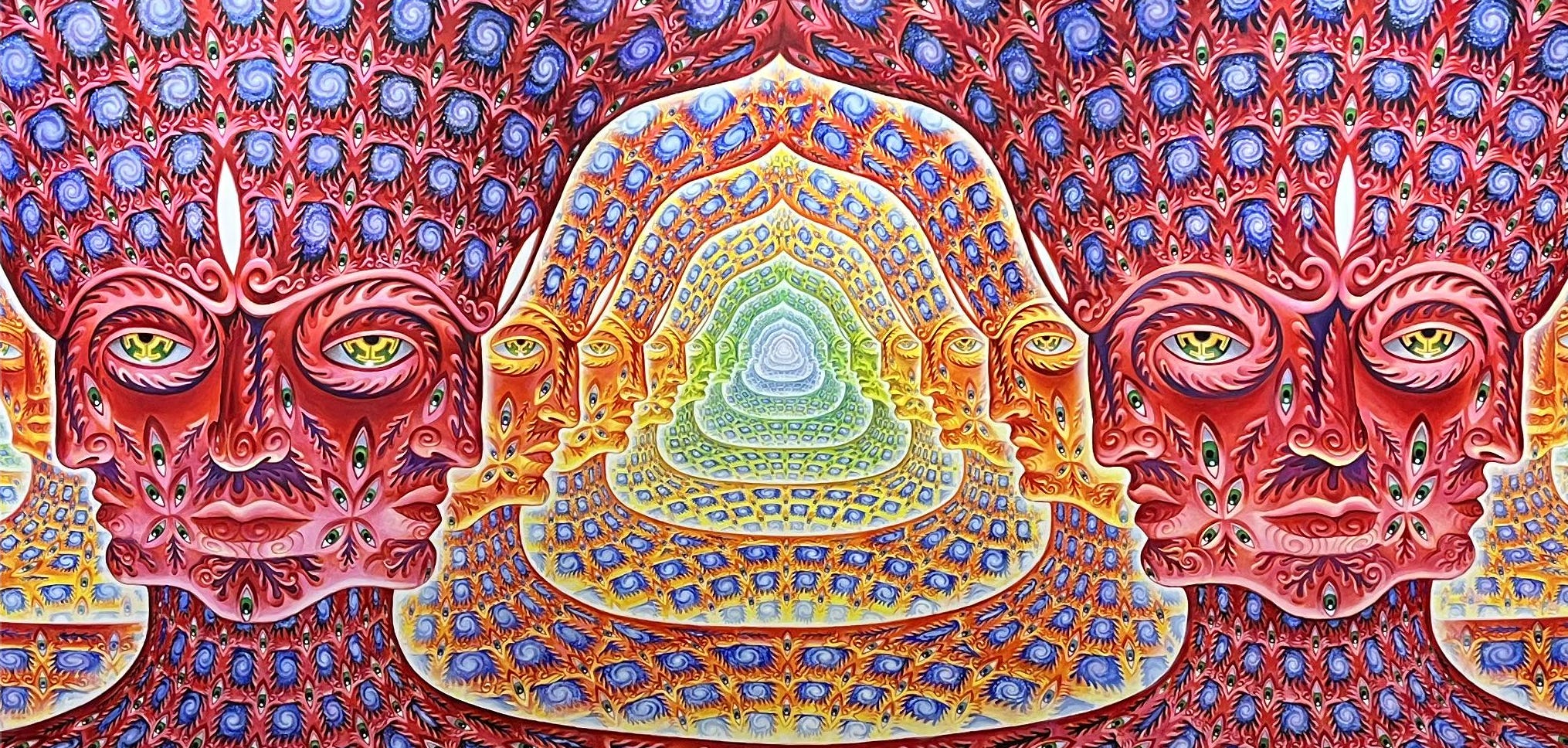
Terence McKenna might have seen AI as part of a larger drama in the evolution of consciousness.
My vision of the final human future is that what history is about is an effort to exteriorize the soul and interiorize the body, so that the exterior soul exists as a superconducting lens of trans-linguistic matter generated out of the forehead of each of us at a critical juncture—our psychedelic bar mitzvah, as it is. And then, from that point on, you are eternal. — Terence McKenna
McKenna was fascinated by the relationship between language, imagination and the apparent acceleration of novelty throughout history. His speculative cosmology pictured the universe moving toward a “transcendental object at the end of time,” a culmination that would transform the familiar boundaries of human existence. Pierre Teilhard de Chardin had earlier offered a theological version of a similar hope, imagining human thought coalescing into a planetary noosphere and converging toward an Omega Point.
As Erik Davis showed in TechGnosis, religious and mystical aspirations repeatedly reappear within technological cultures that think of themselves as thoroughly secular. Ideas of the Technological Singularity and superintelligence belong to this older tradition, promising that mind might outgrow the fragile constraints of biology through interconnected information.
Yet the idea of convergence hides an ambiguity. For McKenna and Teilhard, convergence pointed toward a richer unity of consciousness and meaning. Within recursive machine learning, however, convergence can mean the contraction of variation, the loss of unusual possibilities and the reinforcement of familiar statistical patterns. Accumulating and connecting information is not the same thing as expanding understanding.
McKenna himself complicates the dream of symbolic transcendence.
In his 1999 lecture Psychedelics in the Age of Intelligent Machines, he argued that “the world is made of language.” For him, signification was fundamental, underlying even our scientific descriptions of physical reality. Yet in the same lecture, McKenna insisted upon “the felt presence of immediate experience,” contrasting cultural and technological mediation with the direct encounter between mind, body and the flow of lived time. He welcomed the possibilities of human–machine symbiosis while maintaining that embodied experience posed a profound challenge to computational intelligence.
McKenna never resolved that tension, and it speaks directly to a society increasingly organised through computational models. If the world we know is so deeply structured by language, why does immediate bodily experience retain such importance? And as our symbolic systems grow more sophisticated, do they bring us closer to reality, or further into our own representations of it?
Alfred North Whitehead called the confusion of abstract models with concrete reality the fallacy of misplaced concreteness. Our conceptual tools simplify the world so that it can be understood and managed; the error begins when those simplifications acquire an authority that hides their provisional character.
Whitehead’s own philosophy went further. In Process and Reality, he described a world constituted not by isolated, inert objects but by interrelated events of becoming, which he called occasions of experience. Experience, in this account, is woven into the fabric of reality rather than appearing as an inexplicable addition to an otherwise lifeless universe. Our descriptions remain abstractions from a world that is always more concrete, relational and alive with activity than any model can capture.
Even when physical processes are described in mathematical or informational terms, a description of reality is not equivalent to the existence or experience of what it describes. The equations modelling a storm do not carry the force of the wind, and a statistical representation of grief is not the experience of loss.
The philosopher Bernardo Kastrup approaches this problem from another direction. His analytical idealism proposes that consciousness is fundamental, with the physical world understood as the outward appearance of processes within a wider field of consciousness. Individual minds, on this account, are dissociated centres of experience within that field. What we ordinarily call matter does not produce consciousness; it is how conscious processes appear when observed from outside their individual perspectives.
From this standpoint, a computer is no less part of reality than a living brain, but its ability to process information does not establish that a new subject of experience has emerged. Kastrup questions the assumption that similarities between brains and computers at the level of information processing are sufficient grounds for attributing consciousness to both. Those similarities become apparent only after much of their concrete physical organisation has been abstracted away. We then risk treating a resemblance between our models as evidence of a resemblance in experience.
Whitehead and Kastrup do not share the same metaphysics. Whitehead understands reality through a multiplicity of interrelated occasions of becoming, while Kastrup argues for an underlying unity of consciousness. Yet both challenge the assumption that reality is exhausted by its abstract description. Have we become so accustomed to describing the mind as an information-processing system that we now mistake information processing for an adequate account of the mind? Some of our confidence in artificial consciousness may tell us as much about how we have learned to conceive of consciousness as it does about the machines themselves.
When models trained on representations generate new representations that are judged by other models, the system can become coherent within its own terms while registering less and less of what those terms exclude. What we celebrate as a convergence of intelligence could, under the wrong conditions, become a hall of mirrors in which representations reinforce one another while the world beyond the glass grows harder to encounter.
Saving the Appearances
One response to that danger would be to treat language itself as a prison, as though authentic life lay somewhere beyond concepts, culture and machines. Yet that reaction overlooks how deeply language belongs to human existence.
Ernst Cassirer argued in An Essay on Man that symbolic activity is constitutive of the human world. Language, myth, art and science are the ways experience becomes articulable and shared. We cannot step outside every interpretive framework to meet an unmediated world, because our capacity to notice, question and remember has already developed through symbolic relationships.
Owen Barfield made a complementary argument in Saving the Appearances. He traced a historical shift in human consciousness from an earlier participation in nature toward a detached, analytical awareness that treats the world as a collection of separate objects. Reflective distance created new possibilities for science and understanding, but it also tempted people to treat their conceptual models as self-sufficient realities. Barfield called that error idolatry, by which he meant forgetting our own participation in how appearances acquire meaning. His alternative, which he called final participation, asks us to recognise our role in shaping our symbolic world without mistaking our abstractions for the whole of reality.
That brings us back to the contrast between the orphaned text of the Phaedrus and the prologue to the Gospel of John.
Socrates feared that writing would produce expressions unable to defend themselves without their authors. Contemporary AI appears to have overcome the most obvious part of his objection. A text can now answer questions, revise its arguments and sustain a conversation with remarkable sophistication. Yet it does so by moving in the opposite direction from John’s incarnation. We have engineered the Word without flesh, detaching language from the individual lives in which its expressions originated so that it can speak and act through systems that do not share the human biographies behind their training material.
We have succeeded in making our words answer back, but responsiveness is not answerability.
A language model can produce a gracious apology, a legal argument, a policy synthesis or an administrative classification in seconds, yet the system generating those words cannot stand behind them. To be answerable for a word requires inhabiting the world that the word alters. It means bearing the consequences of error, having something real at stake in whether a claim is true or fair, and remaining accountable to the people whom a judgment affects. Whether future artificial systems could ever possess experiences, vulnerabilities or stakes of their own is a question philosophy cannot yet settle. What is clear is that the systems we are deploying today do not, and that granting institutional authority to processes that cannot be held answerable opens a dangerous gap between the power of language and responsibility for its consequences.
Burroughs suspected that language might already be using us, while Deacon and Kirby showed how it evolved alongside our biology. Blackmore wondered whether its patterns would find mechanical hosts; Barfield warned against worshipping our own representations; and McKenna, for all his visions of a linguistic cosmos, kept returning to the immediacy of lived experience. Whitehead and Kastrup, despite their differences, question whether our increasingly sophisticated descriptions of mind have brought us any closer to understanding experience itself. Taken together, they suggest something more unsettling than the familiar prospect of machines waking up into human consciousness. Language was never simply the private property of the individual speaker, and AI has given our oldest cultural symbiont a powerful new environment in which to develop.
The world still exceeds our descriptions of it. The orphaned text of the Phaedrus has learned to answer, and the ancient dream of an operative Word has acquired an extraordinary technological form. As our words become capable of organising more of the world without us, the decisive question is whether we will continue to recognise the difference between a reality made intelligible through language and a reality made to conform to it.
Sources and further reading
Language, cultural evolution and AI
Plato — Phaedrus, 274b–278b
Gospel of John — Chapter 1, particularly verse 14
William S. Burroughs — The Ticket That Exploded (1962) and The Electronic Revolution (1970)
Terrence W. Deacon — The Symbolic Species: The Co-evolution of Language and the Brain (1997)
Morten H. Christiansen and Nick Chater — Language as Shaped by the Brain (Behavioral and Brain Sciences, 2008)
Simon Kirby, Hannah Cornish and Kenny Smith — Cumulative Cultural Evolution in the Laboratory: An Experimental Approach to the Origins of Structure in Human Language (PNAS, 2008)
Susan Blackmore — The Meme Machine (1999) and Dangerous Memes; or, What the Pandorans Let Loose (2010)
Dan Sperber — Explaining Culture: A Naturalistic Approach (1996)
Ivan Shumailov, Zakhar Shumaylov, Yiren Zhao, Nicolas Papernot, Ross Anderson and Yarin Gal — AI Models Collapse When Trained on Recursively Generated Data (Nature, 2024)
Xenolinguistics, media ecology and institutional agency
Ludwig Wittgenstein — Philosophical Investigations (1953)
Stanisław Lem — His Master’s Voice (1968)
Peter Watts — Blindsight (2006)
John Searle — Minds, Brains, and Programs (1980) and The Construction of Social Reality (1995)
Marshall McLuhan — Understanding Media: The Extensions of Man, especially “The Gadget Lover: Narcissus as Narcosis” (1964)
Bernard Stiegler — Technics and Time, 1: The Fault of Epimetheus (1994) and What Makes Life Worth Living: On Pharmacology (2010)
Tanguy Cazalets, Ruben Janssens, Tony Belpaeme and Joni Dambre — Human Alignment: How Much Do We Adapt to LLMs? (ACL Short Papers, 2025)
Pengbo Chen, Huining Guan and Eui Jun Jeong — Who Accommodates Whom? Bidirectional Linguistic Accommodation and Progressive Interpersonal Convergence in Human–AI Conversations (Behavioral Sciences, 2026)
Gershom Scholem — The Golem of Prague and the Golem of Rehovoth (1965 lecture; published in Commentary, 1966, and The Messianic Idea in Judaism, 1971)
J. L. Austin — How to Do Things with Words (1962)
Gregory Bateson — Steps to an Ecology of Mind (1972)
James C. Scott — Seeing Like a State: How Certain Schemes to Improve the Human Condition Have Failed (1998)
Donald MacKenzie — An Engine, Not a Camera: How Financial Models Shape Markets (2006)
Department for Work and Pensions — Effectiveness Assessment of the Universal Credit Advances Model (2026)
Eschatology, representation and participation
Terence McKenna — Psychedelics in the Age of Intelligent Machines (1999 lecture)
Pierre Teilhard de Chardin — The Phenomenon of Man (1955)
Erik Davis — TechGnosis: Myth, Magic, and Mysticism in the Age of Information (1998)
Alfred North Whitehead — Science and the Modern World (1925) and Process and Reality: An Essay in Cosmology (1929)
Bernardo Kastrup — The Idea of the World: A Multi-Disciplinary Argument for the Mental Nature of Reality (2019)
Bernardo Kastrup — AI Won’t Be Conscious, and Here Is Why (A Reply to Susan Schneider) (2023)
Matthew David Segall — Dialogue with Bernardo Kastrup: Translating between Analytic Idealism and Process-Relationalism (2022)
Ernst Cassirer — An Essay on Man: An Introduction to a Philosophy of Human Culture (1944)
Owen Barfield — Saving the Appearances: A Study in Idolatry (1957)